Return on Investment
This equation represents the sales value chain of malls and retailers. The black variables are all measurable and the red variables are all customer based performance ratios. Given the number of customers visiting a mall or passing retailer premises, sales are a function of the variables in red. Malls measure none of them and typically retailers only measure the last of them. This represents potential to increase sales, which will provide a return on the investment in additional customers counting systems that enable the entire sales value chain to be measured.
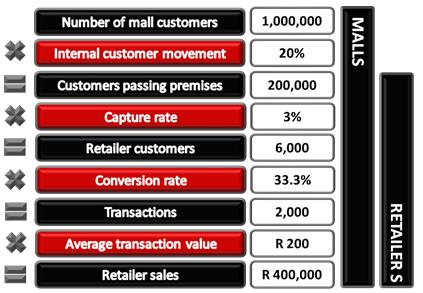
The following illustrates the potential that the first three of these red ratios offers for sales growth. Average transaction value is omitted because it is measured and managed by retailers and so offers little growth potential.
Internal customer movement
The way customers move around within malls impacts on the sales potential of retailers and their ability to pay rental. In the example above, 20% of mall customers use the zone in which the tenant is located. If this is increased to 21%, the tenant’s access to customers and sales potential will increase by 5%.
Capture rate:
Capture rate is a measure of the efficiency with which retailers attract customers into their stores. It is similar to the average number of tenants visited by customers when visiting a mall.
From a mall perspective, assume that customers visit an average 2 tenants every time they visit a mall. If this is increased by one additional tenant visit every 10 trips to the mall, tenant customers will increase by 5% (21 is 5% higher than 20).
From a retailer perspective, assume that a specific retailer attracts 1 out of every 1000 passing customers into its store. If it attracts one more out of every 10,000 passing customers into its store, it’s number of customers will be 10% higher (11 is 10% higher than 10).
Conversion rate
Conversion rate is a measure of the efficiency with which retailers convert visitors to their stores into buying customers.
Assume that a retailer sells to 20 out of every 100 customers entering its store. If it sells to only one more customer out of every 100 customers, transactions and sales will be 5% higher. If it sells to 2 more out of every 100 customers, it’s transactions and sales will increase by 10%, etc.
None of these three variables are currently measured or managed, so each offers sales growth potential. Each also impacts on dwell time so will contribute to increased parking revenue (if applicable).
In addition, passing customers impacts not only on sales potential but also on rental potential and ideal size of premises. So counting customers internally will also give added insights into rental imbalances and size of premises problems. The value of this is difficult to quantify but evidence suggests it will be significant (available on request).
The potential this offers for yield growth exceeds that of any other initiative because it focuses on improving basic efficiencies. To realise this potential customers must be counted at a few points within malls and entering retail premises. The cost of doing this will be justified by the impact it will have on sales.
